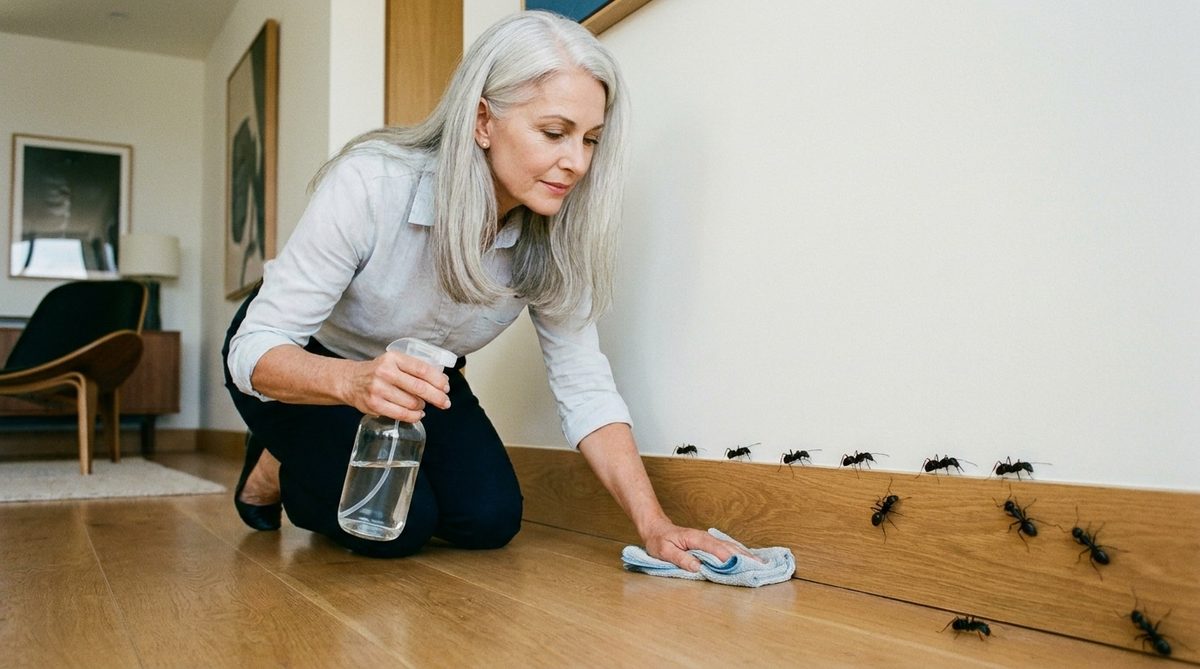
It happens on a spring morning. The sun is out. A single crumb drops. Suddenly, the skirting boards look like a highway.
You clean. You move the bin. You hide the sugar. It doesn’t matter. They are back. Always at the same spot. Always in a line.
It is not magic. It is chemistry. Ants use pheromones as an invisible GPS. One worker finds food. She marks the path. The others follow. They reinforce the scent. The trail gets stronger. Your baseboards are the perfect route. They are protected. They are out of the way of foot traffic. They connect the floor to the wall corners.
Regular cleaning fails because it looks clean to you. It does not erase the scent to them.
The fix is simple. You likely have it in your kitchen cupboard. White vinegar. It breaks the trail. It stops the invasion. No lab coat required.
Why ants choose your baseboards as a highway
Ants do not wander randomly. They follow a chemical map.
When a scout finds a food source, she lays down pheromones. Other workers pick up that signal. They walk the same line. They add more scent. The path becomes a dedicated corridor.
Baseboards are ideal for this. Why?
- Continuity : A long, unbroken line along the floor.
- Protection : Shielded from air currents and casual foot traffic.
- Structure : Corners, joints, and door thresholds guide movement.
- Microclimate : They often hold more stable temperatures and slight humidity, especially under sinks or behind heavy furniture.
Food falls near these zones. Sugar under a table. Crumbs near a worktop. The ants find it. They mark the route along the baseboard.
Here is the problem with standard cleaning. Soap and water remove visible dirt. They do not always neutralize the specific organic compounds in pheromones. The floor shines. The scent remains. The ants keep going.
Why white vinegar erases ant trails
You do not need to kill every ant. You need to confuse them.
White vinegar is acidic. It has a strong odor. It breaks down the chemical bonds of the pheromone trail. It effectively “erases” the map.
When the scent disappears, the column breaks. Ants hesitate. They scatter. They cannot find the food source again.
This is more durable than a scented spray. Lemon-scented cleaners mask the smell. They do not remove it. The ants can still detect the underlying chemical signal. Vinegar destroys it.
Do these mistakes though and it will fail:
- Too weak : A dilution that is too light leaves enough signal for ants to retrace their steps.
- Masking : Mixing it with strong perfumes or heavy detergents can neutralize the acid or mask its effectiveness.
- Rinsing : If you wipe it off with clear water immediately, you remove the active agent before it works.
- Wrong timing : Spraying randomly across walls is useless. Hit the trail when you see it.
Material safety matters.
Vinegar is safe for most modern baseboards. Tile, PVC, and washable paint handle it fine. Be careful with raw wood, waxed wood, or delicate finishes. The acid can dull or damage them. Test a small, hidden spot first. If the paint is old, proceed with caution.
How to apply vinegar to stop ants on baseboards
Preparation is key. Do not just spray and hope.
- Clear the food source. If there is sugar or crumbs, the ants will come back regardless of the trail. Vacuum the corners. Wipe the floor. Remove the incentive.
- Identify the path. Watch where the line forms. Look for the bottleneck. That is your target.
The mixture:
- 250 ml white vinegar
- 250 ml warm water
Equal parts. Simple.
The application:
Use a microfiber cloth. Dip it in the solution. Wring it out well. You do not want to soak the wood or paint.
Wipe the baseboard. Focus on the bottom edge. Focus on the corners. Focus on the joints where the wall meets the floor.
How often?
Every day for a few days while you see activity. Then, switch to maintenance. Wipe as soon as you see a scout.
Where to focus:
- Door thresholds
- Radiators (heat attracts them)
- Under the sink (humidity + food smells)
- Behind the trash can
- Pipe junctions
Leave the vinegar to air dry. Do not wipe it off with water. Let the smell do the work.
Reinforce the barrier to prevent return
Breaking the trail is step one. Keeping them out is step two.
Once the path is erased, the house becomes “unreadable” to the colony. They have to start searching from scratch. This buys you time.
Seal cracks. Fix gaps. Keep the area dry. Store food in sealed containers.
The goal is not a sterile lab. It is a home that does not invite them.
Vinegar is a tool. It is cheap. It is effective. But it requires consistency. If you miss a spot, they will find it. If you let the food sit, they will return.
Watch the edges. Keep them clear.
The trail is gone. For now.
Seal the gaps to stop ants from coming back
White vinegar masks the trail. It works. But it’s a temporary fix if you leave the front door open. Literally.
Ants don’t need a highway. They use micro-cracks. A tired sealant joint. The gap around a cable entry. A hole near a pipe. These are their highways.
Fix them. Use a simple acrylic or silicone sealant. Apply it cleanly. Close the entry point. Check the bottom of doors and damaged thresholds. That’s usually where the first scout slips in. Then she calls the rest.
The goal is simple. Reduce entry points. Break their path as close to the source as possible.
Remove the food reward to break the cycle
Your house doesn’t have to be dirty to attract ants. It just has to offer a reward.
A bin that doesn’t seal tight. A pet bowl left out too long. A damp sponge. Overripe fruit on the counter.
Manage these things. Empty the bin more often. Store sugary foods in sealed boxes. Wipe counters. Watch wet zones.
Less reward means faster abandonment. This pairs well with wiping baseboards and neutralizing scents. If there’s nothing at the end of the line, why walk it?
When to escalate and what not to do
If the invasion is massive, or if you suspect a nest nearby (persistent activity despite scrubbing trails), step up your game. Don’t scatter your efforts.
Check outside. Look at the base of walls. Find active cracks. Combine actions. Seal. Clean. Repeat.
Don’t break the strategy. If you erase the trail but leave the food accessible, the colony will just build a new route. Consistency matters. Barrier plus hygiene is the winning combo.
Why ants return and how to keep them gone forever
The key is acting on what ants actually read: olfactory trails.
Run white vinegar along baseboards. Especially where the line is thickest. The route gets confused. The column drops off.
Timing matters as much as the product. Do it every few days at first. Then switch to targeted maintenance at the first sign of trouble.
For a long-term lock, combine everything. Neutralized baseboards. Better management of crumbs and moisture. Sealed entry points.
Ask yourself this: which corners of your house still offer a perfect shortcut to food without you even knowing it?


