You see six legs. You see a head, a thorax, and an abdomen. You panic.
Is it ants or termites? It matters because one eats your drywall and the other just eats your crumbs. But to the naked eye in a moment of stress? They look like identical, tiny invaders. They’re both social. They both have queens. They both have workers who do the heavy lifting and soldiers who defend the colony. Size varies wildly within both species. One minute you’re looking at a speck, the next you’re staring at a bug that looks like it could lift a grain of sand.
Stop guessing. Here is how you actually know which pest you’re dealing with.
Зміст
The Physical Tell: Waist, Wings, and Antennae
If you catch one in the act, stop and look. Do not crush it yet.
The Waist
Look at the connection between the thorax and abdomen.
* Ants have a pinched, thin waist. It looks like an hourglass.
* Termites have a thick, broad waist. Their body looks like a straight tube or a thick sausage. There is no pinch.
The Wings
Are they flying? If so, the wing length tells the story.
* Ants have two pairs of wings. The front wings are significantly longer than the back wings.
* Termites have two pairs of wings that are equal in length. They look symmetrical.
The Antennae
Hold the bug under a light.
* Ants have elbowed antennae. They bend.
* Termites have straight antennae. They look like little beads on a string.
“If the waist is thick and antennae are straight, you have a termite. If the waist is pinched and antennae bend, it’s an ant.”
Behavior and Structure: Where They Live
If you can’t grab the bug, look at the evidence.
The Dirt Mounds
Found a pile of dirt near your foundation? Or in a wall void? That’s almost certainly ants.
Ants dig nests. They pull earth out and pile it up. They keep this debris neatly away from their entrance. If you see concrete cracks with ants marching in and out, and piles of soil nearby, you’re dealing with an ant colony. They are visible. They are not shy. They live in holes or nests built from the earth.
The Hidden Tunnels
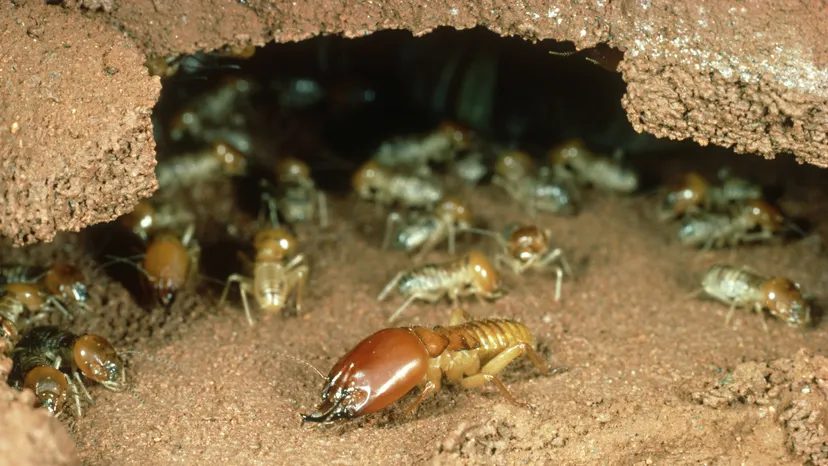
Termites do not build visible dirt mounds. They don’t dump debris like ants do.
Termites live in the soil but stay hidden. They build mud tubes to travel from the ground to your wood. If you see pencil-thin lines of mud running up a foundation or across a basement wall, those are termite tunnels. They seal the entrance to the wood they’ve entered. You won’t see them working. You’ll only see the damage or the mud.
What They Eat (And Why It Matters)
This is the big one. The cost difference.
Ants
Ants are omnivores. They eat just about anything. Protein. Sugar. Grease. If you leave a crumb on the kitchen floor, they will find it.
Crucially: Ants do not eat wood. They use wood for nesting, yes. They might chew through soft wood to make a tunnel. But they don’t consume the cellulose for food. They eat the crumbs you drop.
Termites
Termites eat wood.
They consume it for sustenance. They don’t just live in it. They digest it.
Worker termites are blind. They navigate by following pheromone trails and tunnels they’ve built. They eat through your structural lumber, your floorboards, your door frames. They stay hidden inside the wood, sealing off the entrance behind them.
“Ants eat your leftovers. Termites eat your house.”
The Damage Question: Which Is Worse?
Most people assume a termite infestation is automatically worse than an ant infestation.
That’s not necessarily true.
Ants can cause significant structural damage too. Some species chew through insulation. Others nest in wall voids, creating moisture issues. But their damage is usually localized and cosmetic until they get really bold.
Termites cause structural damage because they are eating the load-bearing wood itself. They hollow it out. A house can look fine on the outside while the frame is compromised.
Both can wreak havoc. Both require intervention.
How to Get Rid of Them
Once you’ve identified the pest, don’t guess with chemicals.
For Ants
Treat with an insect