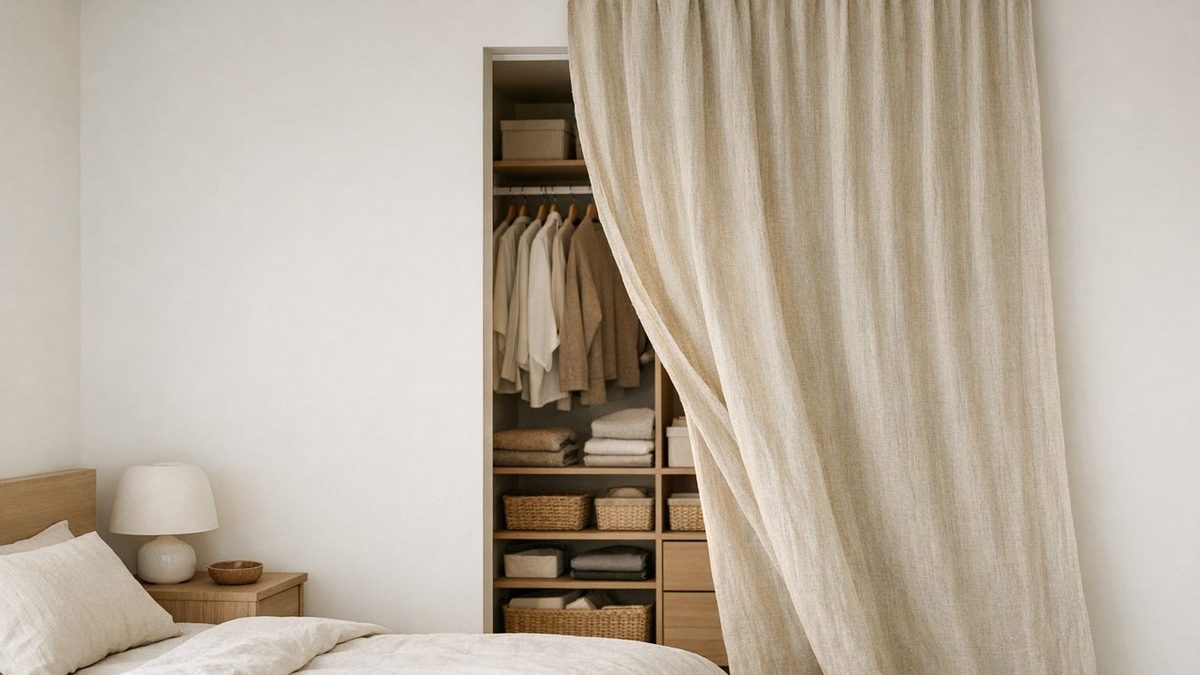
There was a time when open wardrobes were fashionable. It exploded in the 2010s, riding the wave of New York lofts and minimalist Pinterest boards. It promised to turn your clothes into decor. By 2026, that promise has flipped. The trend is turning. Simple curtains, usually under 50 euros, are a bridge between good looks and neatness.
This is not just an aesthetic problem. It’s about physics and economics.
The ugly truth behind the appearance of the “boutique”.
Open wardrobes are popular because they are affordable. Rod and Shelf systems cost 2 to 8 times less than custom built-in wardrobes. This price tag explains the initial boom. But open storage is cruel. It demands daily discipline. Wrinkled T-shirt. A pile of unstable sweaters. The stylish boutique atmosphere instantly turns into a permanent garage sale.
There is also dust. It’s not the romantic floating dust you see in the movies.
The real kind.
According to the French Indoor Air Quality Observatory, daily dust concentrations in homes vary between 6 and 10 milligrams per square meter.
This phenomenon can accumulate significantly over several weeks on clothing exposed to air. This is especially visible in dark fabrics.
The light is worse. UV light bleaches the fibers.
Silk, linen and bright colors fade quickly. One fabric cover can reduce dust and UV exposure by 80-90%.
Let’s think about money. The average Frenchman spends about 1,600 euros a year on his wardrobe. Not protecting these clothes means wasting hundreds of euros every few years. For a piece of fabric.
Why curtains are the smartest DIY update of 2026
Covering the wardrobe with curtains is the fastest and cheapest solution. Forget the sliding doors that cost around 300 euros. Forget hiring a carpenter. Interior architects are now publicly defending this choice.
This year, curtains play an important role in modern design. It’s no longer a budget compromise for renters. They are thoughtful design statements. Let’s take Mill-a Studio’s small house project as an example. Here, the dressing room is separated with curtains and neutral tones are combined. Creates a soft but defined border. Soft fabric. Neutral tones. Textured material. The wardrobe becomes a part of the structure of the room rather than an eyesore.
Furniture retailers report that over 40% of homeowners’ storage cabinet choices include curtains. Why? Flexibility. For renters who can’t drill holes in their walls, these are the only viable option. You can change the fabric depending on the season. No permanent changes. Just a stick and cloth.
How to choose and install curtains like a pro
A basic unit with rods and cotton or linen curtains costs 20-50 euros. Fixed spiral rods made of high-quality fabric cost 80-100 euros. It’s a far cry from a custom closet.
The choice of fabric affects the finish. Too light? Voile, muslin or basic polyester will wrinkle. It shows you what’s inside. It will look temporary. Natural linen brings warmth and bohemian style. Velvet adds a touch of luxury. Heavy cotton is classic and easy to care for. In the cabinets, you must try to use opaque fabrics with a weight of at least 200 g/m².
Installation follows three rules that do-it-yourselfers often get wrong.
- Hang it high. Place the bar or rail as high as possible. The ideal installation location is the ceiling or 5 cm below it. This visually lengthens the room. The gap between the curtain and the ceiling becomes less noticeable.
- Go wide. The width of the fabric should be 1.5-2 times the width of the opening. There should be enough material to form natural pleats when closed. Tightly drawn curtains look like cheap rent.
- Mind the floor. The curtains should only touch the floor. Do not pull the space more than 1 cm.
Here is the secret most guides ignore. If you use two separate panels, add a hidden magnetic snap in the middle. It costs a few euros at the sewing store. It keeps the panels tight. Prevents the light strip from passing through the center. The amount of investment is small. The difference is huge.
The cabinet remains hidden. Your clothes stay safe. Maintain an airy, loft-style look without worrying about maintenance. Or maybe you just like the sound of the curtain sliding back in the morning.
Washed linen is dominating the material landscape for 2026. It is not just about the look. The natural crease, the soft hand-feel, and hypoallergenic properties make it a strong contender for every room. For a wardrobe, it is even more relevant. Linen breathes. It regulates humidity naturally and does not trap odors.
Velvet presents a different case. Its thick texture makes it an excellent thermal and acoustic insulator. A velvet curtain creates an instant sense of cocooning and refinement. In urban bedrooms where street noise invades the closet space, this is a non-negligible bonus. You are buying quiet as much as you are buying fabric.
Why Japanese panels are worth the technical hassle
Japanese panels deserve their own category. They are beautiful, but they require a bit more technique to install correctly. The main advantage is that they slide laterally on a rail. They cover wide openings without the bulk of pleats. The result is highly architectural. It leans toward a Scandinavian aesthetic. If your dressing is wider than 150 cm, this is the ideal solution.
Sustainability is no longer a niche trend. It is established. Curtains made from recycled fibers are gaining ground. Polyester from plastic bottles, organic cotton, and hemp are improving in quality and variety. In 2026, these materials are not an aesthetic compromise. They offer drapes and finishes comparable to conventional textiles. You do not have to sacrifice style for ethics.
The hidden value of fabric protection
Interior designers know something most guides omit. A well-installed wardrobe curtain should not look like a closure. It should look like a decorative element. Raw linen adds a bohemian touch. Off-white colors integrate perfectly into a Scandinavian scheme.
The dust protection becomes almost anecdotal in the face of the visual effect. Yet, that is precisely why this solution has convinced professionals. Protecting clothes from dust and discoloration extends their lifespan by 20 to 30 percent on average. An investment of about 50 euros pays for itself by preserving the value of your wardrobe over the seasons.
Sources : meubles.fr | habitat-essentiel.com