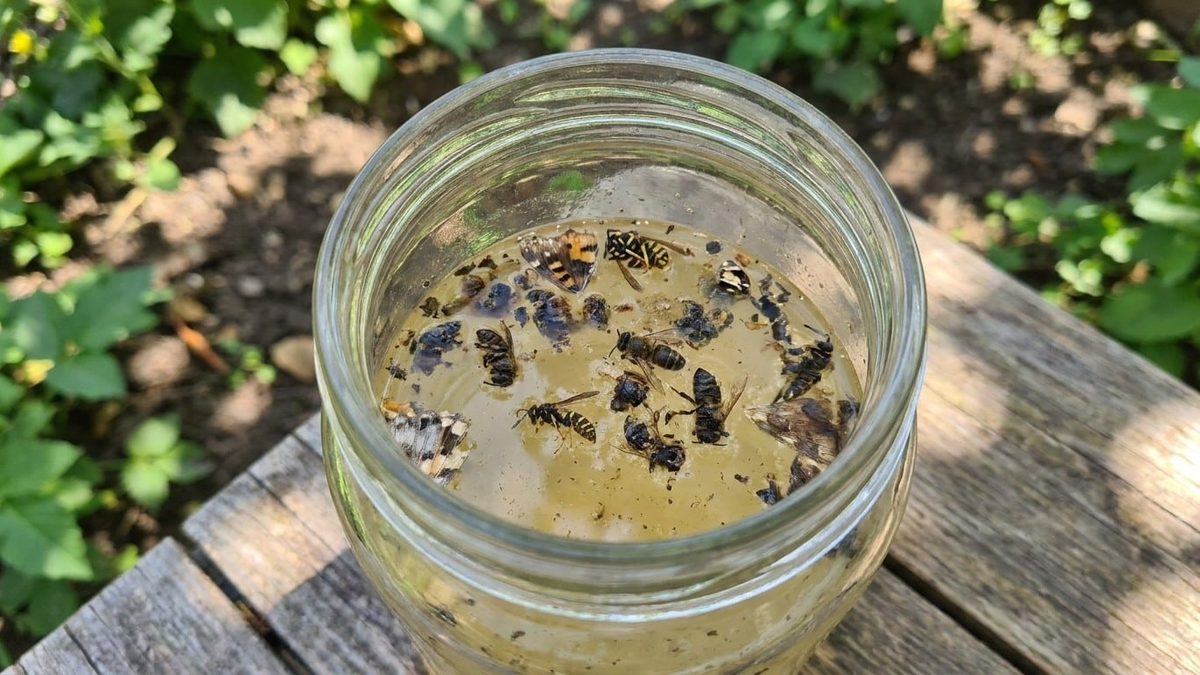
You set up a jar in June. You empty it in August. What do you find? A few drowned Asian hornets. And dozens of bees, bumblebees, hoverflies, and butterflies.
This is the silent autopsy of millions of French gardens every summer. The homemade sweet trap—our reflex against the yellow-legged hornet—doesn’t do what we think it does.
Here is the hard truth:
- What you find in your jar in August will shock you.
- Summer worker hornets rarely fall for sweet traps.
- There is a three-month window where trapping actually changes the game.
The trap in August contains mostly the wrong victims
Devices made with sweet and alcoholic mixtures are dangerous for pollinators. Wild bees, bumblebees, butterflies, and other garden helpers die in large numbers. The Asian hornet population isn’t reduced. This isn’t just specialist nuance. It’s a reality you can see by looking into your trap.
The Office for Insects and their Environment (Opie) and the French Federation for the Protection of Nature (FNE) have stated this clearly. Studies from the National Museum of Natural History confirm it. When you trap in spring using bottle or bell traps, more than 99% of captured insects are other species.
Not 10%. Not 50%. Ninety-nine percent.
The Asian hornet often walks right past the trap.
Why? Because the adult hornet, unlike its carnivorous larvae, feeds on sugar itself. Larvae eat insects and bees. Adults consume sugars like ripe fruit, nectar, or sap. A beer and grenadine syrup mix attracts adults seeking carbohydrates. Most of those are useful insects looking for the same thing.
Summer worker hornets hunt protein-rich prey to feed the nest. The sweet trap interests them only mildly.
The Asian hornet is a predator on a different scale
The Asian hornet is a real problem. It is serious. It is documented.
One study estimates a single nest consumes over 11 kilograms of insects between March and October. About 38% of that is honeybees. Eleven kilograms equals roughly 100,000 individuals per season. French beekeeping associations estimate annual economic losses at €11.9 million.
Every year, 20% of French honeybees die from Asian hornet attacks. Predation peaks in summer and autumn. At these times, the bee colony shrinks naturally. The hornet colony reaches its peak. This biological synchronicity is brutal. The hive is most vulnerable when the predator is strongest.
The desire to put a trap in your garden is understandable. The problem isn’t the motivation. It’s the method. And the timing.
The only window that matters: March to May
The biology of the Asian hornet offers a narrow opportunity in spring. Most gardeners miss it completely.
Founding queens emerge from diapause around mid-April. They need sugar to establish the first cells of the nest. Neutralizing a queen at this stage often prevents an entire colony from being born.
The spring trapping window is a maximum of two months. It starts as soon as temperatures warm, usually between March and May. This is the only period where trapping makes sense at a territorial level. After months of inactivity, the founding queen urgently needs sugar to restart her metabolism. She becomes vulnerable to a well-designed bait.
Real data exists. In Brec’h, Morbihan, a network of 125 volunteers captured 7,772 founding queens during the 2024 spring campaign. Project leaders called this a national benchmark. This isn’t amateur tinkering. It’s a coordinated campaign with calibrated traps over a defined period.
Some communes recommend a bait recipe: one-third beer, one-third grenadine syrup, one-third white wine. This attracts hornets while sparing bees, who aren’t drawn to alcohol.
Scientists still temper enthusiasm. A study by ITSAP and the National Museum of Natural History shows that trapping founders can alter nest distribution and density. Effects vary by environment and trapping intensity. Data shows many founders die naturally. Late cold, lack of food, competition, and predation limit their survival. Removing one individual doesn’t guarantee one less nest. But collective effort, when organized, produces measurable results.
Still, the jar in your garden right now? It’s likely holding more victims than villains.
Destroy, Don’t Trap: The New Legal Reality for Asian Hornets
The spring window for intervention has closed. What remains is far more direct: active destruction of identified nests. This isn’t just advice anymore. It’s the law. Under the regulations introduced in March 2025 and reinforced by the national combat plan launched in March 2026, the government has shifted its strategy. Reporting the nest is now the mandatory first step. You must flag it to your local municipality to trigger a professional removal. This framework is legally binding, moving away from voluntary recommendations toward enforced action.
The scale is significant. The national plan mobilizes 3 million euros annually for six years. But money and laws don’t change biology. And biology is why you need to stop trapping in the summer.
Why Summer Traps Are an Ecological Disaster
If you put out a sweet bait trap between June and August, outside of apiaries, you are doing more harm than good. The standard plastic bottle trap with sugary bait doesn’t distinguish between threats and helpers. It’s a one-way ticket. Once an insect enters, it drowns. There is no escape.
This indiscriminate killing is ecologically catastrophic. In August, emptying that jar isn’t a count of pests removed. It’s a tally of collateral damage. You are drowning syrphus flies. You are drowning butterflies. These insects pollinate your garden flowers. The Asian hornet, by contrast, doesn’t touch those plants.
The irony is brutal. The sweet trap you set to fight the hornet actually weakens the very insects the hornet is already decimating. The Asian hornet preys on 1,449 insect species. Among them are 43 out of the 50 most consumed pollinator species. We’re talking about the domestic bee, the earth bumblebee, and the meadow bumblebee.
Acting Against Your Own Interests
When you trap in summer, you aren’t protecting your garden. You’re helping the hornet. By removing native pollinators, you reduce the natural predators and competitors that might otherwise keep local insect populations in check. You are effectively doing the hornet’s work for him.
The strategy has flipped. Effective combat now relies on two things: immediate reporting of nests to authorities for safe destruction, and restraint during the peak summer months. Stop feeding the hornet traps. Start feeding your bees. The plastic bottle stays on the shelf until the threat level drops and the legal mandate for destruction takes full effect.