You flip a switch. The lamp lights up. It feels easy. That’s not it.
There are two main methods of creating this glow, and the method used depends entirely on the ballast in your light. The most common setup you see today is the rapid start system. It is a workhorse for both commercial premises and homes.
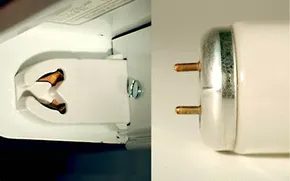
Unlike older models, rapid start lamps do not use a start switch. They rely on a ballast to ensure that current flows continuously through both electrodes. This creates a charge difference across the tube. When you turn it on, the electrode filaments heat up quickly. They boil off electrons. These electrons hit the gas inside the tube and ionize it. When the gas is ionized, an electric arc is created. Charged particles flow through the tube and hit the mercury atoms. Mercury releases light.
It’s a chain reaction. Quickly. Effective.
Instant-Start Alternative
Not all fluorescent lamps turn on in the same way. You may come across Instant Start bulbs. They take a completely different approach. Instead of preheating the filaments, they apply a very high initial voltage to the electrodes.
This high voltage causes a corona discharge. Think of it as electrons being pushed onto the surface of an electrode until they pass into a gas. The result is instant ionization. An arc is created almost immediately. No warm-up time. No flickering.
Both methods lead to the same result: an electric current passes through the ionized gas. This is called gas discharge.
Why supervision is important
Herein lies the gas discharge problem. It is unstable. If you don’t manage the current carefully, it just won’t stay constant. It increases. Continuous.
Without a flow-limiting ballast, the current gets out of control. The device may overheat. It can fail. In extreme cases, it can explode.
Ballast is the unsung hero here. It acts as a resistor and keeps the current under control. Without it, the light just wouldn’t come on. It would destroy itself.
Next, we look closely at how this ballast stabilizes the flow. And why ignoring it is a bad idea.