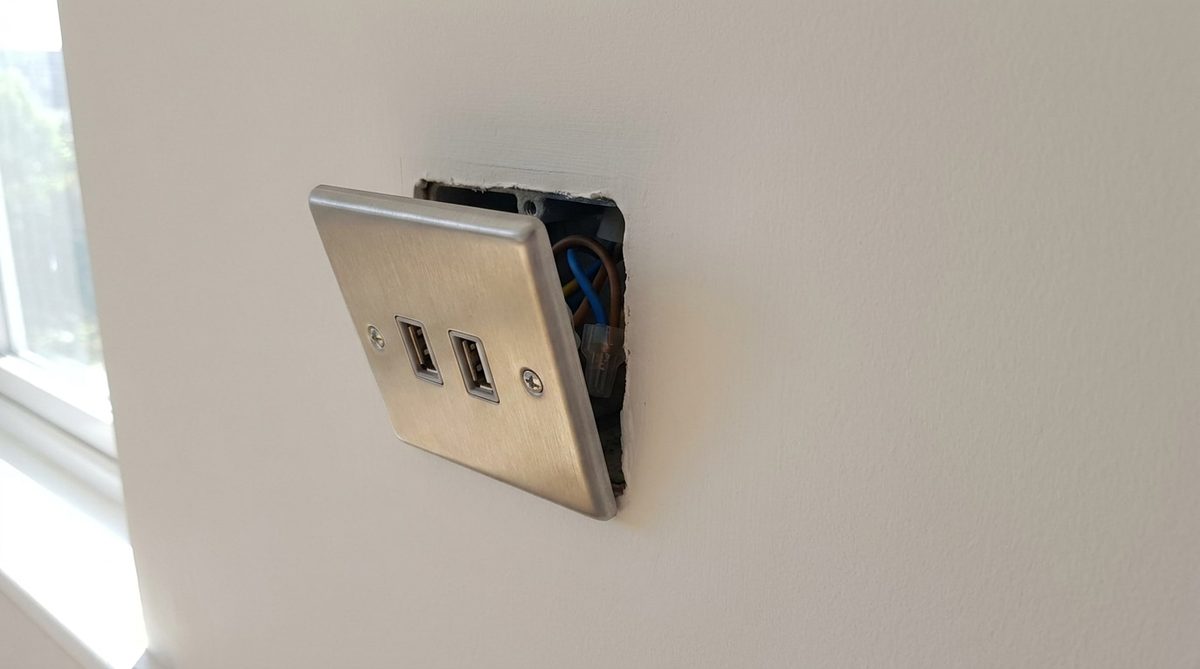
Spring is the season when the interiors are refreshed. I want to organize my living room. No need to look for an adapter on the sofa. Replacing your old outlet with a model with an integrated charging port can solve your clutter problem. It is immediately convenient on a phone or tablet.
There is a catch.
Silent dangers often lurk beneath sleek, modern panels. Using this hardware seems simple at first glance. But if you ignore the basic rules, the wall installation can become a heat trap. If proper precautions are not taken, the metal inside the plaster may heat up insidiously. This significantly increases the risk of electrical fire.
You must pass five specific checks. They are non-negotiable. Prevents overheating. They ensure that the renovation work is safe.
Зміст
Remove the power from the source.
Before touching the screwdriver, the energy must be removed.
Turning off the power at the circuit breaker is your first line of defense. It sounds obvious, but people mess it up. If the refrigerator is running or other appliances are on, it may seem easier to flip the main switch from the main switch. However, isolating certain circuits is the only reliable method.
A properly maintained electrical panel has labels that tell you which circuit breaker controls which room. Look at the board. Find the line for the outlet you are working on.
If you are unsure. If the sticker is faded or missing. Cut a wider perimeter. Better to keep your kitchen in the dark for an hour than risk an electric shock. circuit breaker shutdown means protected area. It acts as an obstacle in preventing major accidents.
Verify Zero Voltage
Trust, but verify.
Don’t assume the line is dead even if the breaker is off. Confirming zero voltage is mandatory. Use a reliable multimeter or a separate voltage tester. Don’t rely on “smart” socket indicators.
Insert the probe tip into the power outlet. The display should show that the residual voltage is absolutely zero. No matter what you read, it means you are not safe.
He has proven experience and can handle conductors calmly and without tension. Prevents unpleasant and unexpected vibration when lifting old upholstery.
Make sure the cable can handle the USB current load
A small transformer is hidden in the socket with the USB port. Converts standard alternating current to direct current. This process generates considerable heat. It is not visible to the naked eye. Real to the physics.
You need to check the copper wire embedded in the wall. For standard distribution, the cable cross-section must be at least 2.5 mm². Upstream it can be 1.5 mm2.
Sub-dimensioned wires generate heat during continuous use. A twisted or frayed thread is like a ticking clock. If the wire is too thin, the outlet will become a radiator.
Check the ground wire
The green and yellow wires are inactive during normal operation. It plays an important role when something goes wrong.
Verified grounding protects occupants from sudden transformer failure. Stray leakage current flows to ground. Ignoring a corroded or loose ground connection can expose your home to a sparking hazard.
Controlled parts and test surfaces are part of the protective measures. They guarantee a long service life. They keep your home safe.
Give the New Outlet Breathing Room
The electronic body of the USB connector is bulky. Much larger than a standard light switch.
Older wall sockets were only 30 mm deep. This is not enough. You need to extract the existing container. Replace it with a box that is at least 40mm deep, or in some cases 50mm or more.
adequate junction box enables the creation of a small dissipation zone. Prevents heat build-up from all sides. Space is not a luxury here. This is a safety requirement.
When placing the block, be careful not to pinches Forcing electronic devices into tight housing is a fatal mistake. When the insulating copper is pressed against the cylinder wall, the plastic coating becomes thinner. The metrics influence each other. Spot heating becomes more efficient.
The spacious container allows the wiring to be folded into an accordion. Achieves a smooth installation. Eliminates dangerous mechanical stress.
This covers hard stops. power, voltage, wire gauge, grounding and depth. You have overcome the immediate danger. However, the installation is not complete until the panels are attached and the final testing is completed.
There are still some things that need to be done before the circuit breaker is turned back on.
The device does not generate heat. It comes from the wall.
Most fires caused by electrical outlets do not occur in the kitchen or near heaters. They start behind baseboards. The cause is usually a loose connection. If the wire is not properly attached to the connector, a resistance spike will occur. This resistance produces heat. It also produces micro-arcs. Small, invisible electrical pulses jump across gaps in the metal. Produces enough heat to melt the insulation. Light the plasterboard on fire. A quiet night turns into an emergency.
You can’t see this happening. But you can stop it.
Lock each wire to prevent micro-arcing.
The secret to no-fail installations is not high technology. This is torque.
Depending on the socket brand, the connectors use spring clamps or screw clamps. Both require the same thing: complete immersion. Strip your wire correctly. Push all the bare copper into the hole. Do not leave exposed wires hanging. Exposed edges are a fire hazard waiting for dust bunnies or the slightest movement inside the box.
If you use screw terminals, tighten them tightly. If you use push-in connectors, press them firmly. You need to feel the wire lock. If there is resistance, the wire is either too thick or stripped incorrectly. Don’t force it. Strip more insulation. Try again. The goal is a zero-gap connection. There is no air. No movement. It’s just metal-to-metal contact.
Pull test: no excuses needed
Before you screw the faceplate back on, perform the pull test.
This sounds elementary. Grab the thread. Pull gently. Not a jerk. It’s just a steady draw.
The cord should not move. Not even 1 mm.
If you can wiggle it, the connection is loose. Loose joints reduce energy transfer. It means resistance. It means heat. Every time you plug in a high-draw device, the loose wire vibrates a little and the vibration widens the gap. This gap can cause sparking. The arc melts the plastic. The molten material ignited the wooden stud.
If the wire moves, strip it again. Re-insert. Tighten up. Try again.
The only way to ensure safety is to make sure the clamp is properly closed. It’s boring work. It’s tedious. This is the difference between a safe house and a burning house.
5 invisible protections to keep your family safe
It’s not just about installing a socket. You build shields.
The right renovation optimizes the safety of your walls. Here’s a checklist to prevent heat disasters.
– Turn off the power. ** Flip the breaker. Don’t guess.
– Verify zero voltage. ** Use tester. Make sure it’s dead.
– Check section and ground. Make sure the wire gauge matches your circuit. Ensure the ground is solid.
– Use the correct box. ** There are cracks in the old box. New boxes hold. Use a new housing that is deep enough.
– Check the fasteners. ** Perform a pull test.
Want to skip a step? You have left a chink in your armor. Don’t skip it.
The Relief of Clean Power
Next, connect your laptop. Charge your phone. The connection hums silently.
There is no buzzing. There is no spark smell. There is no thermal radiation from the plate. The new cell works in perfect silence. It dissipates heat naturally into the calibrated environment. The device remains cool to the touch. Robust. Safe.
That’s the goal. It’s not just functionality. Peace of mind.
Get the job done
Home improvement is more than just aesthetics. It’s about survival.
Doing common repairs accurately can make DIY a safe and fun activity. Clear gestures remove technology anxiety. They will bring you a peaceful night.
The sun is coming out. The house is quiet. Why not check out the other electrical outlets in the room? Or the kitchen backsplash? The pattern is the same. cut. test. Strip. Push. Tighten up. Pull.
One outlet at a time. Until the whole house feels safe.