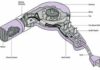
Stop and unplug the tool. Seriously. It sounds like common sense, but folks rush this part every single time. You are dealing with a spinning metal disc that can turn a finger into pulp in milliseconds. Do not skip the disconnect.
Once the power is off, locate the arbor nut. This is the bolt holding your blade in place. Most saws come with a specific spanner or Allen key. Use it. If you lost that tiny piece of metal, a socket wrench might work, but stick to the tools designed for the job to avoid stripping the nut.
Here is the tricky part. You need to stop the blade from spinning while you turn the nut.
If your saw has a shaft lock button, push it. It freezes the motor shaft so you can work. No shaft lock? Grab a pair of vise grips or a clamp. Squeeze the blade carefully. Do not crush the teeth. Just hold it still.
Now, which way do you turn?
The nut always tightens in the opposite direction of the saw blade’s rotation.
Think about it. If you turned it the same way the blade spins, the rotation would just unscrew the bolt during every cut. The blade would fall off. Dangerous.
Most circular saws are right-handed. The blade spins counterclockwise. So, you tighten the nut clockwise. Left-handed saws spin clockwise, meaning you tighten counterclockwise. Check your model.
Hold the outer flange of the nut with one wrench. Keep that flange from turning. With your other hand, use the spanner to tighten the nut in the direction you determined above.
Do not over-torque it. You do not need to summon the strength of a weightlifter. Hand-tight plus a solid quarter-turn with the tool is usually enough. If you strip the threads, you are buying a new saw.
Check the blade alignment. Is it sitting straight? Is the guard moving freely? Poorly maintained power tools cause preventable accidents. If you cannot get it tight, or if the blade wobbles, stop.
Take it to a professional. Or buy a new saw. Do not force a power tool. It will bite back.